
Aftermath of the 1956 Suez Crisis - Global Ramifications
Posted: Wednesday 25th March 2026
Event Date: Saturday 28 March
Location: In person and online
Venue: National Maritime Museum, Greenwich
Organisers: Naval Dockyards Society
Sponsor: Society for Nautical Research
Naval Dockyards Society 30th Annual Conference
Aftermath of the 1956 Suez Crisis: Global Ramifications and Reflections for Dockyards and Shipyards
Writing a decade after the Suez crisis, one contemporary politician dismissed the affair as merely ‘the dying convulsion of the British Empire.’ This view is still widely held today, but how authentic is that interpretation in hindsight? How did the Suez crisis redefine Britain’s international identity and economic profile and its relationship with former colonies and ongoing allies? And how did it influence attitudes among Britain’s allies, including France and Israel, who had taken part, and the United States who had forced an early end to the action? Critically, how did the Suez aftermath and its often-bitter recriminations shape future British naval policy on home and overseas dockyards and shipyards and their communities?
Click HERE to register by 27 March
Programme
9.30–11.00 REGISTRATION Coffee/Tea
10.00–10.50 AGM (NDS members only)
11.00–12.20 Morning Conference - "Laying the foundations for the post-Suez global transfer of naval power". Chair Ian Stafford
11.00–11.40 Dr Samantha Middleton, ‘From Convoys to Crisis: How the WWII Maritime Infrastructure Shaped Britain’s Strategic Failure in Suez and Its Aftermath for Dockyards and Shipyards’
11.40–12.20 Dr David F. Winkler, ‘Setting the Stage: The Suez Crisis and Eventual Withdrawal of British Presence East of Suez’
12.20–1.20 Coffee/Tea served – Obtain lunch in one of the Museum’s dining venues.
1.20–3.20 Afternoon Conference - "Home and overseas dockyard case studies". Chair Dr Andrew Jeffrey
1.20–2.00 Richard Holme, MPhil, ‘Sheerness dockyard 1956-2026: Bad and good news!’
2.00–2.40 Chen BI, ‘From Imperial Base to Commercial Lease: The Governance Transformation of Malta Dockyard after the Suez Canal Crisis’
2.40–3.00 Afternoon short break
3.00–4.30 Afternoon Conference continued - "A springboard for further study." Chair Dr Ann Coats
3.00–3.40 Dr David F. Winkler, ‘Filling the Void: The Reluctant Superpower East of Suez’
3.40–4.20 Andrew Livsey, MA, ‘The British naval requirement for dockyards and support facilities, 1956 to 2026’
4.20 Brief final questions, comments, Valediction
4.30 END
Find out more about the Naval Dockyard Society.
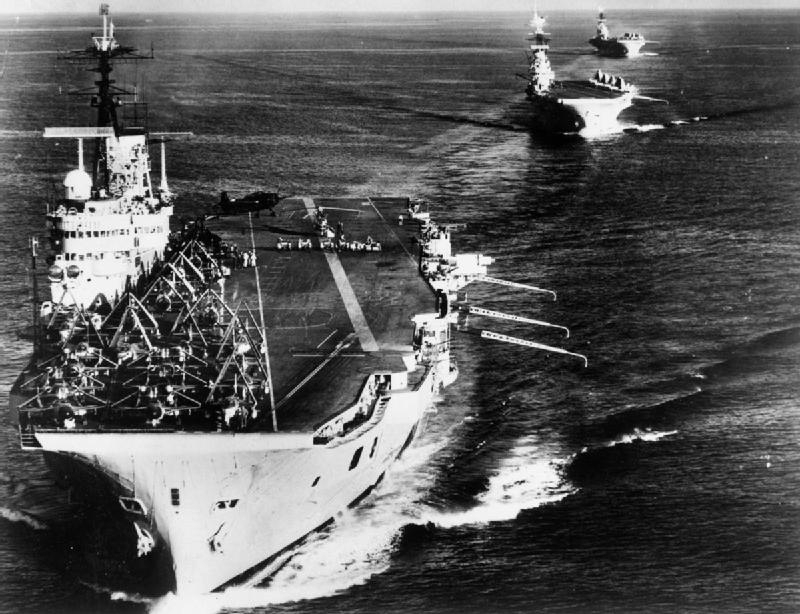
Image source: File:British carriers during Suez Crisis 1956.jpg - Wikimedia Commons
Three of the five British aircraft carriers involved in the Suez operation: HMS Eagle (R05) leads HMS Bulwark (R08) and HMS Albion (R07).
Photograph A 33601 comes from the collections of the Imperial War Museums

